Ask any German learner what drives them crazy, and the answer is almost always the same: der, die, das. Why is it der Tisch but die Lampe and das Buch? Why is a girl, das Mädchen, neuter?
Here's the good news: German genders are not as random as they look. Many nouns carry a clue in their ending, a few simple groups follow fixed rules, and the rest becomes easy with the right habit. Let's take them one by one.
First: why it matters
The article isn't just a little word in front of the noun. It changes the words around it, too:
- dergroße Tischthe big table
- diegroße Lampethe big lamp
- dasgroße Buchthe big book
If you know the gender, adjective endings, pronouns (er, sie, es) and cases fall into place much more easily. If you don't, you're guessing in every sentence. That's why it's worth getting right from day one.
The endings that give it away
Many German nouns tell you their gender through their ending. Learn these, and you'll know the article of hundreds of words without memorising them one by one.
Almost always die
- dieZeitungnewspaper (-ung)
- dieFreiheitfreedom (-heit)
- dieMöglichkeitpossibility (-keit)
- dieFreundschaftfriendship (-schaft)
- dieInformationinformation (-ion)
- dieUniversitätuniversity (-tät)
- dieBäckereibakery (-ei)
- dieKulturculture (-ur)
Almost always der
- derFrühlingspring (-ling)
- derTourismustourism (-ismus)
- derMotorengine (-or)
- derTeppichcarpet (-ich)
- derHonighoney (-ig)
- derPolizistpolice officer (-ist)
Almost always das
- dasMädchengirl (-chen)
- dasFräuleinyoung lady (-lein)
- dasDokumentdocument (-ment)
- dasMuseummuseum (-um)
- dasThematopic (-ma)
There are a few exceptions, of course (it's German!): das Ei, der Moment, die Firma. But these endings are right far more often than they're wrong, and that's a huge head start.
Groups with fixed rules
Some groups of words always share the same article. These are easy points:
Days, months, seasons → der
der Montag, der Januar, der Sommer. Every single one.
Weather → der
der Regen, der Schnee, der Wind, der Nebel.
-chen and -lein → das
Small versions of things are always neuter, even people: das Mädchen, das Brötchen.
Verbs used as nouns → das
das Essen (food/eating), das Lernen (learning), das Schwimmen (swimming).
Compound words → the last word decides
das Haus + die Tür = die Haustür. die Bahn + der Hof = der Bahnhof.
Plural → die
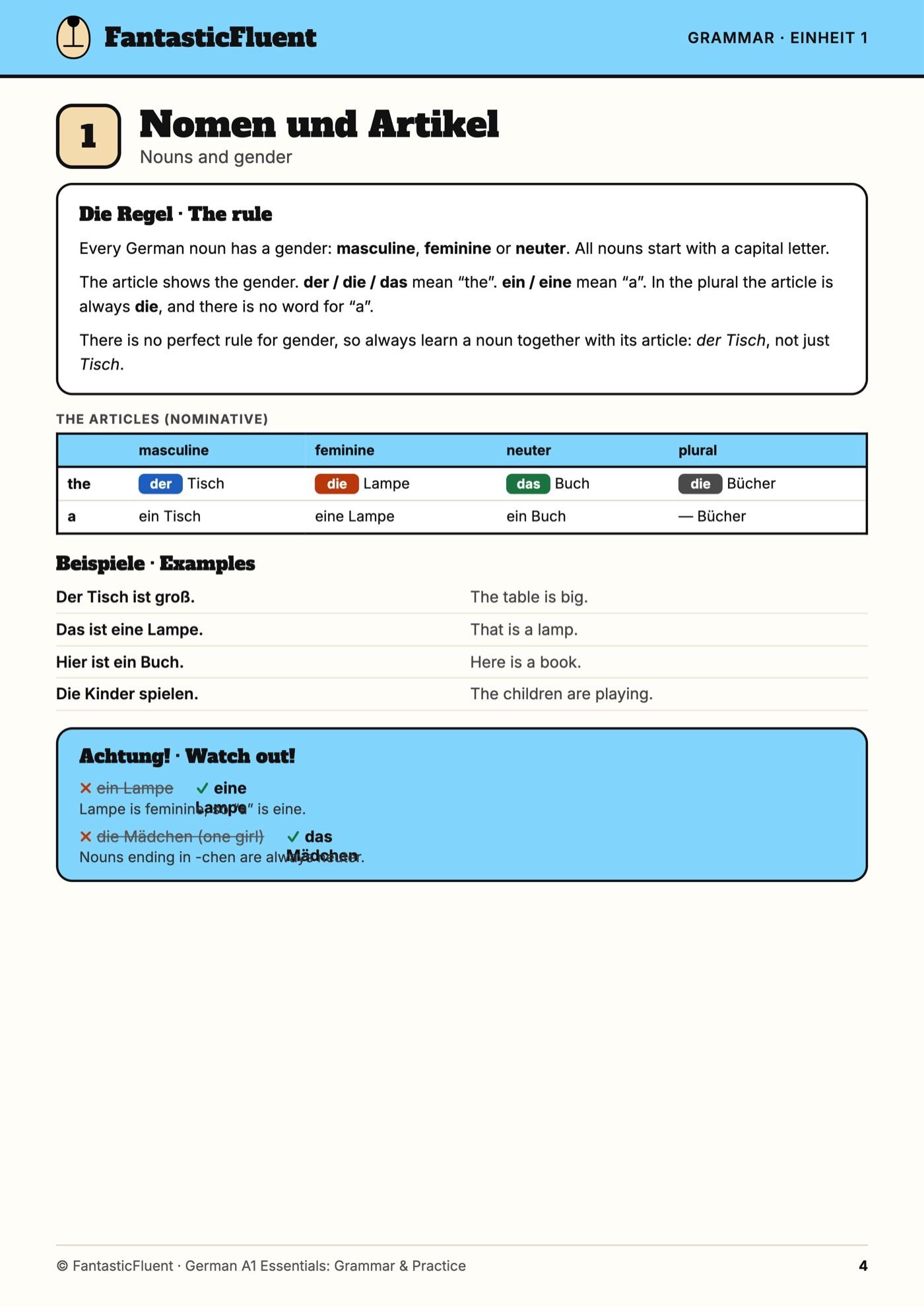
die Tische, die Lampen, die Bücher. In the plural (nominative) there's only one article to remember!
The colour trick
Our brains remember colours much more easily than little grammar words. That's why all our books colour-code the articles: blue for der, red for die, green for das.
When you write a word in your notes, write it in its colour, or put a coloured dot next to it. After a while, you don't think "is it der or die?" anymore. You simply see the word in red, and the article comes with it.
You can go one step further and give each article a picture in your head:
- der = something strong and heavy, like a big blue bear
- die = something red and elegant, like a red rose
- das = something small and green, like a little green frog
To remember der Löffel (spoon), picture a bear eating with a huge spoon. For die Gabel (fork), picture a rose stuck on a fork. It sounds silly, but silly pictures are exactly what memory loves.
Guess the article
Time to practise. Look at each word, decide on der, die or das, then tap the card to check. Use the ending rules above!
Tap a card to reveal it.
Quick quiz
Which article is it?
1.What is the article of "Gesundheit" (health)?
2.What is the article of "Häuschen" (little house)?
3."Der Bahnhof" (station) is made of "die Bahn" and "der Hof". Which part decides the article?
4.What is the article of "Bücher" (books)?
5.Which of these is masculine?
Your der-die-das habit
The rules get you most of the way. A small daily habit does the rest.
Build the habit
0 / 7 done
Practise a little every day
Articles stick through repetition: seeing, saying and using the same words again and again. Our German books are built for exactly that:
- [German Vocabulary & Practice](/german/a1/vocabulary): every noun from A to Z with its article, plural and English translation, colour-coded, with practice after every letter.
- [German Grammar & Practice](/german/a1/grammar): starts with nouns and articles in Unit 1, with tables, typical mistakes and exercises.
- [German A1 Crash Course](/german/a1): 14 new words a day, always with their colour-coded article, plus video lessons with Fluto.
Viel Erfolg, and remember: der Erfolg (success) is masculine! 🐻