You've landed, you've found your room, and your suitcase is still half full. Welcome to Germany! The first week is exciting, and a little overwhelming: forms in German, shops that close on Sundays, and a recycling system with more bins than you thought possible.
The good news: you don't need perfect German to survive it. A handful of phrases, a few key words and some cultural know-how will get you a long way. Let's go through them, day by day.
The phrases you'll use every single day
Learn these before you arrive, or on the train from the airport. Say each one out loud: you'll need them at the bakery tomorrow morning.
Tap a card to reveal it.
Day 1–2: Your room, your street, your supermarket
Your first trips will be to the supermarket and the bakery (die Bäckerei). Germans take bread seriously, so expect a lot of choice.
Tap a card to reveal it.
Sunday = closed
Most shops, including supermarkets, are closed on Sundays and public holidays. Do your big shop on Saturday.
Pfand: money back for bottles
Many bottles and cans carry a deposit (Pfand). Return them to the machine in the supermarket and get money back.
Bring some cash
Card payment is common, but small bakeries, kiosks and cafés sometimes only take cash.
Bring your own bag
Bags at the checkout cost extra, so most people carry a foldable shopping bag.
Day 2–3: The paperwork (don’t panic!)
German bureaucracy has a reputation, but it’s very manageable once you know the order of things. Here are the words you’ll see on every form, with their genders. Learn the article with the word: the colours help.
- dieAnmeldungregistration of your address
- dasBürgeramtcitizens’ office
- derTerminappointment
- derMietvertragrental contract
- derReisepasspassport
- dasKontobank account
- dieKrankenversicherunghealth insurance
- derStudentenausweisstudent ID card
1. Register your address (Anmeldung)
Within two weeks of moving in, you must register your address at the local Bürgeramt. Book a Termin (appointment) online as early as possible, because slots fill up fast. Bring your passport and the Wohnungsgeberbestätigung, a form your landlord fills in to confirm you live there.
2. Bank account and health insurance
You’ll need a German bank account for rent and bills, and health insurance is required to enrol at university. Many students sort both out in the first week. If you came with a blocked account (Sperrkonto) for your visa, your monthly money will be paid out from there into your normal account.
3. Enrol and get your student card
Once enrolled, you get your Studentenausweis. At many universities, your semester fee also includes a public transport ticket, so check before you buy one!
Tap a card to reveal it.
Day 4–5: Campus life
Time for your first lectures! The words you’ll hear on campus:
- dieVorlesunglecture
- dasSeminarseminar (small class)
- derHörsaallecture hall
- dieMensastudent canteen
- dieBibliotheklibrary
- dieWGshared flat (Wohngemeinschaft)
- derMitbewohnerflatmate (male)
- dieMitbewohnerinflatmate (female)
The “academic quarter”
A lecture listed as “10 c.t.” starts at 10:15. “c.t.” (cum tempore) gives you 15 minutes. “s.t.” (sine tempore) means exactly on time.
Du or Sie?
With professors and officials, use the formal Sie. With other students, du is completely normal from the start.
Eat at the Mensa
The student canteen is the cheapest warm meal around. You usually pay with your student card.
Quiet hours
In most buildings, nights and Sundays are quiet time (Ruhezeit). Save the vacuuming for Saturday.
Day 6–7: Living like a local
Two more things that surprise almost every newcomer:
- Waste separation. Paper, packaging, organic waste and everything else go into different bins, and glass goes into public containers sorted by colour. Ask your flatmates which bin is which. They’ll be happy to explain (in detail).
- The red man means stop. Even if the road is empty, Germans wait at a red pedestrian light. Crossing anyway earns you some disapproving looks, and especially in front of children, it’s considered a bad example.
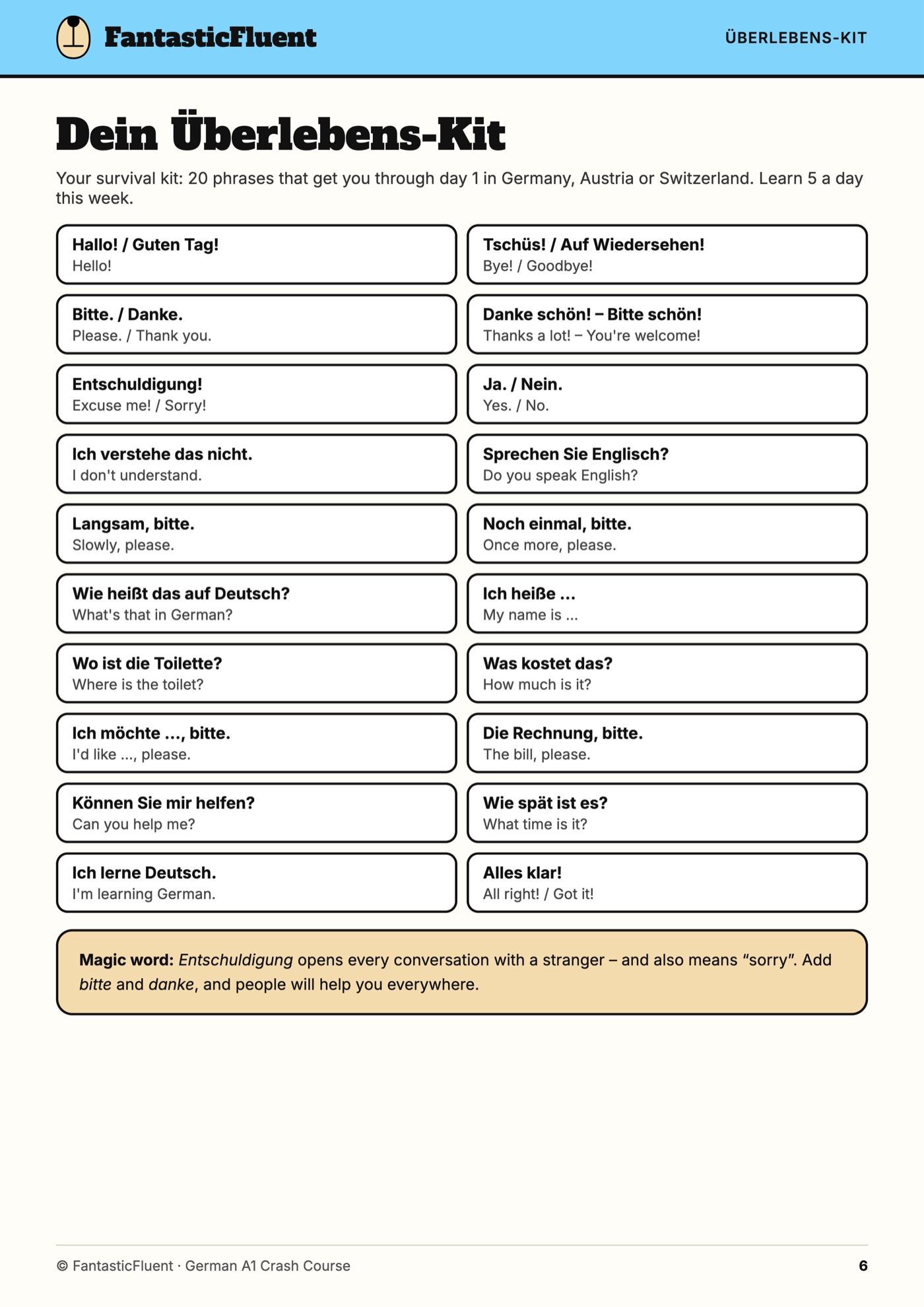
Here’s one of the pages from the beginning of our German A1 Crash Course: twenty phrases that get you through day one.
Test yourself
How ready are you?
1.It’s Sunday afternoon and your fridge is empty. What happens if you go to the supermarket?
2.Your lecture says “14 c.t.” When should you be there?
3.The waiter asks “Zusammen oder getrennt?” What do they want to know?
4.Which of these do you need for your Anmeldung?
Your first-week checklist
Tick things off as you go. Your progress is saved in this browser.
Your first week in Germany
0 / 10 done
Keep going: a little German every day
The first week is about surviving; the weeks after are about really understanding what’s going on around you. The best way is a short lesson every day: 30 minutes on the tram, at breakfast, or before bed.
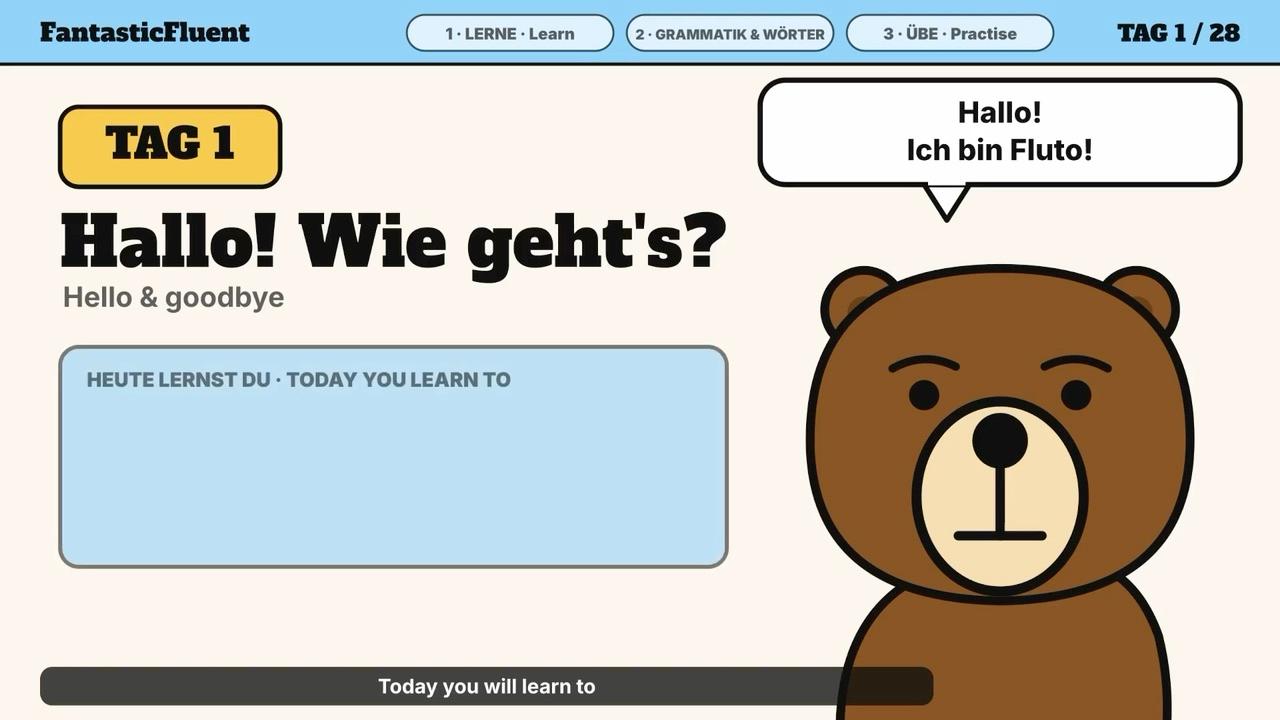
Our German A1 Crash Course does exactly that: 28 days, one short lesson a day, with real situations like the ones above, from ordering in a café to seeing a doctor. The complete course adds video lessons with Fluto, our bear teacher, who walks you through every day and helps you with pronunciation.
Viel Erfolg, good luck with your first week!